From Formation to Removal: Understanding THMs and the Role of Forced Spray Aeration


Trihalomethanes, or THMs, are a group of disinfection byproducts that form when naturally occurring organic matter in water reacts with chlorine used for primary disinfection. This reaction is common in surface water sources where dissolved organic carbon is abundant. When chlorine meets these organic compounds, a series of complex oxidation reactions occur, producing four regulated THMs. These include chloroform, bromodichloromethane, dibromochloromethane, and bromoform.
THM formation is influenced by several key factors. Water temperature, pH, organic carbon concentration, THM speciation levels, and the presence and type of disinfectant all contribute to the extent of THM production. Warmer temperatures and higher organic content tend to drive higher THM formation. Systems with coastal or brackish influences may also experience elevated brominated THM formation due to higher bromide concentrations.
THMs are regulated because long term exposure has been associated with human health concerns. Although chlorine disinfection is essential for preventing waterborne disease, excess THM concentrations can pose risks when left unmanaged. For this reason, the EPA regulates total THMs with a maximum contaminant level. Water utilities therefore need effective tools to reduce THM concentration without compromising disinfection.
One proven method for post formation removal is a treatment approach based on the fundamental behavior of volatile compounds in water, forced aeration.
The Science Behind THM Removal Using Forced Spray Aeration
Forced spray aeration relies on the principles of mass transfer. Volatile compounds dissolved in water transfer into air when exposed to an air interface and provided adequate mixing energy. The efficiency of this transfer depends largely on a compound’s Henry’s law constant. This value describes the ratio between a chemical’s concentration in air and its concentration in water at equilibrium. Compounds with high Henry’s law constants are more easily removed through air stripping. Those with lower constants require more contact time or more aggressive mixing to achieve the same removal performance.
The four regulated THMs have different volatilities and different Henry’s law constants. Chloroform, or trichloromethane, is the most volatile of the group and therefore strips out most easily. Bromodichloromethane and dibromochloromethane have lower volatilities, making their removal more challenging. Bromoform, or tribromomethane, has the lowest volatility and is the most difficult to remove from potable water. Any effective THM removal system must therefore be engineered to address the full range of these volatilities.
A common question during discussions of aeration based THM removal concerns chlorine. Chlorine gas itself is volatile and therefore easily stripped from water. However, chlorine does not remain as chlorine gas in treated drinking water. Instead, it rapidly hydrolyzes to form hypochlorous acid. This form of chlorine has very low volatility and does not readily transfer into air, so it remains in solution. This allows utilities to remove THMs without compromising disinfectant residuals when using forced aeration.
Applying Forced Aeration with IXOM Watercare’s SN Series System
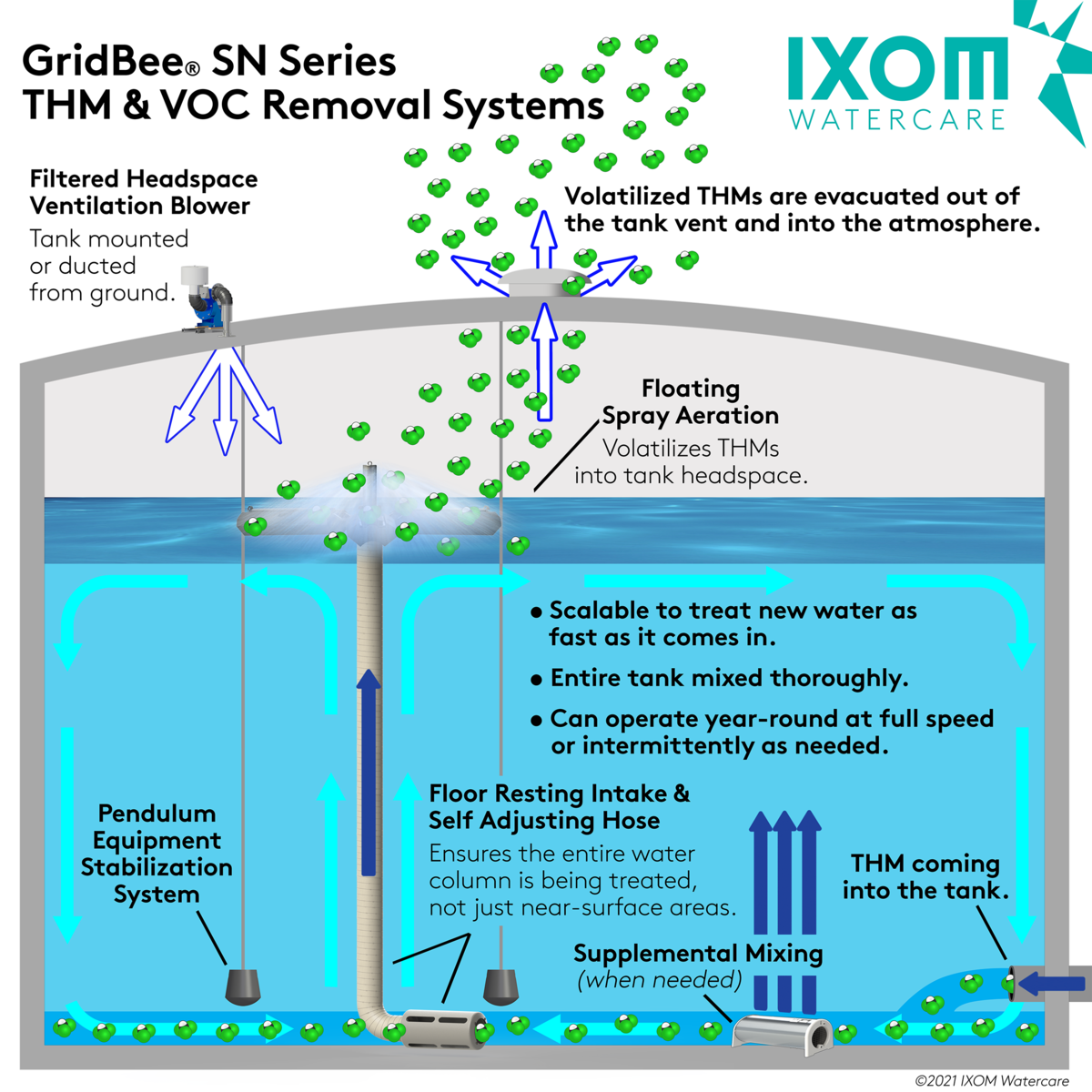
IXOM Watercare’s SN Series system applies these scientific principles to deliver reliable THM reduction in potable water storage tanks. This system uses engineered air movement and optimized mixing to maximize the mass transfer of volatile THMs from water into air. The design focuses on ensuring continual movement of fresh atmospheric air through the tank while promoting strong internal circulation. This creates an efficient and sustained stripping environment.
The SN Series system enhances THM mass transfer in several ways. First, it increases the surface area interaction between water and air. A larger interface accelerates the movement of volatile THMs into the air phase. Second, the system uses dedicated blowers to encourage consistent ventilation within the tank. This prevents stagnation in the airspace above the water and maintains the concentration gradients needed for efficient stripping. The ventilation of THMs into the atmosphere during this process is considered negligible and does not cause environmental harm. Third, the system improves circulation within the water column. Effective circulation reduces stratification and temperature variations that can inhibit the stripping process. It ensures that water throughout the tank passes through regions with strong air contact.
Because the system uses forced aeration rather than chemical addition, its operation is straightforward and avoids the introduction of new treatment byproducts. It is also adaptable to different tank sizes, seasonal conditions, and source water characteristics. These qualities make it suitable for municipalities managing seasonal THM formation, as well as utilities with elevated brominated THM fractions where more efficient mass transfer performance is needed.
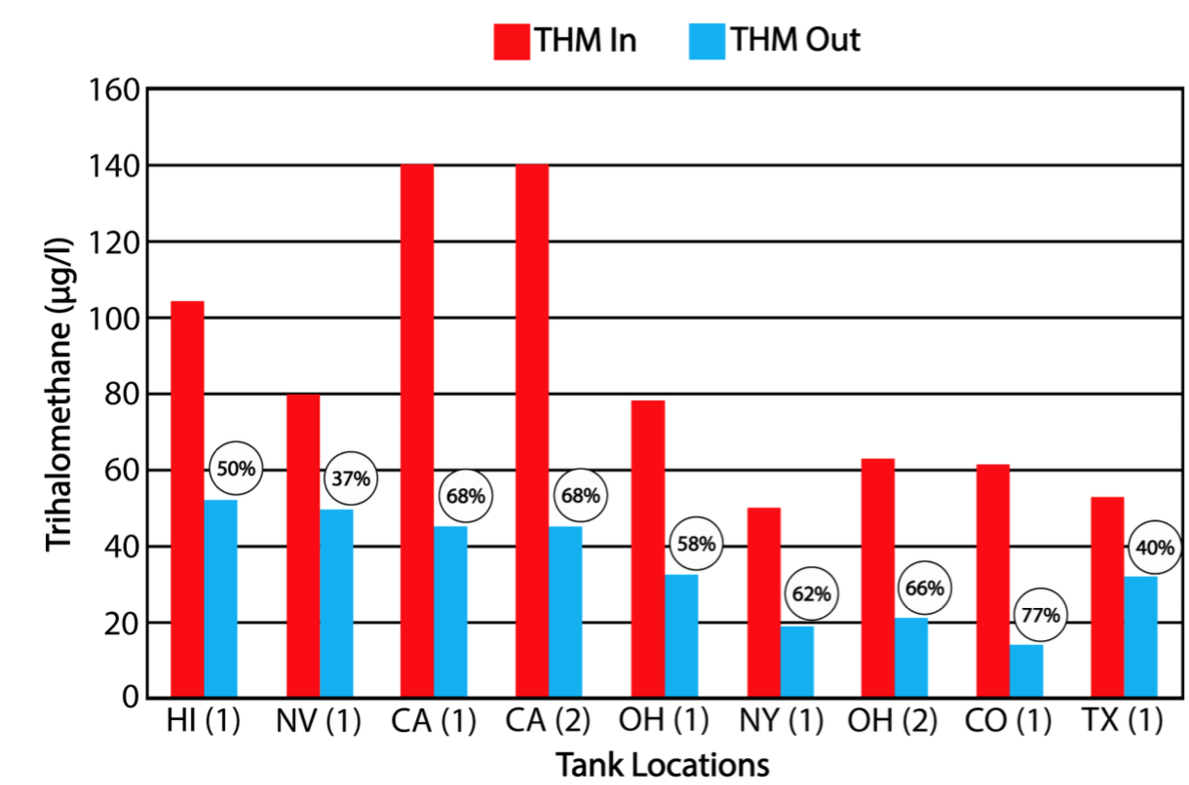
The system’s performance becomes clear when considering how different THM species respond to repeated treatment cycles within the spray aeration process. Chloroform is readily reduced with fewer cycles while bromodichloromethane and dibromochloromethane require more repeated exposure to achieve meaningful removal. Bromoform, the most persistent THM, benefits from the system’s continuous circulation pattern that drives each water parcel through multiple mixing and spray aeration contact events. This design approach ensures that even the most resilient THM species receive the sustained treatment needed for reduction across the full THM spectrum.
Highlighting the SN Series Solution
IXOM Watercare’s SN Series system provides a proven solution for water utilities working to reduce THM concentrations inside potable water storage tanks. By applying the principles of Henry’s law, mass transfer, and engineered forced aeration, this system helps utilities maintain compliance with regulatory standards while preserving disinfectant residuals and operational simplicity. The SN Series stands as an effective and adaptable technology for addressing THM challenges in municipal water systems.